

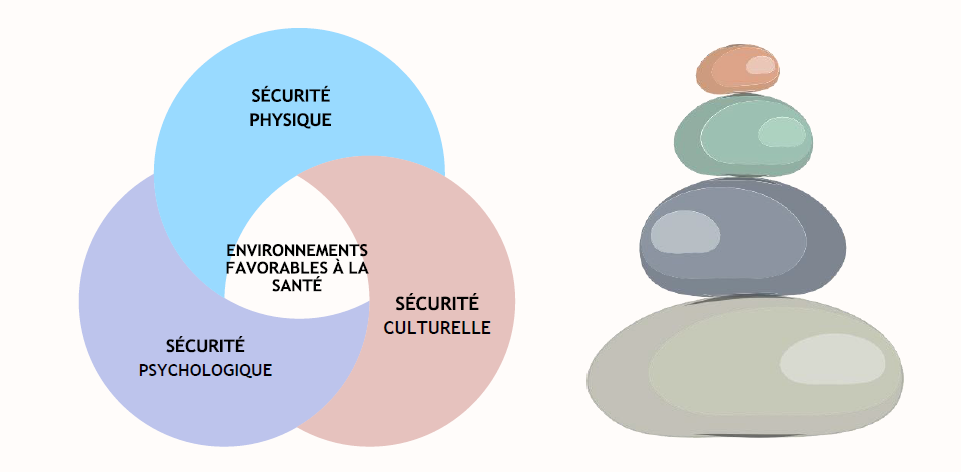
Lancer une initiative ou une action favorable à la santé au sein de votre faculté peut sembler une tâche colossale. Commencez par déterminer clairement où concentrer votre énergie et vos ressources.
Une évaluation des besoins peut constituer un point de départ précieux, vous aidant à comprendre les atouts, les lacunes et les opportunités actuels au sein de votre environnement, et garantissant que vos priorités s’appuient sur des données et des points de vue diversifiés.
Dans la mesure du possible, veillez à ce que le processus soit inclusif, transparent et itératif, et partagez les résultats avec la communauté afin de bâtir la confiance et de maintenir l’engagement.
Que peut inclure une évaluation des besoins ?
Des enquêtes et des questionnaires pour recueillir des avis auprès des apprenants, des enseignants et du personnel
Des groupes de discussion ou des séances d’écoute pour explorer les expériences de manière plus approfondie et recueillir des points de vue variés
L’analyse des données existantes (par exemple, enquêtes d’engagement, indicateurs de bien-être, rapports d’incidents, évaluations)
Analyses contextuelles des espaces physiques, des dynamiques sociales et des conditions organisationnelles
Des revues des politiques et des processus afin d’identifier les lacunes ou les incohérences par rapport aux principes de promotion de la santé
Recensement des initiatives et des ressources existantes afin de comprendre ce qui est déjà en place et d’identifier les lacunes ou les doublons
Une fois que vous avez analysé les besoins de votre établissement, vous pouvez commencer à définir et à hiérarchiser vos actions. Ancrer les priorités dans une évaluation réfléchie permet de concentrer les efforts et les ressources là où ils auront le plus d’impact et jette des bases solides pour un changement durable et significatif.
Tenez compte des éléments suivants :
Actions : identifiez des étapes claires pour atteindre chaque objectif.
Partenaires clés : déterminez qui doit être impliqué (direction du corps professoral, administration, patients, apprenants, etc.)
Indicateurs de réussite et rapports : définissez des indicateurs mesurables pour suivre les progrès, ainsi que les éléments clés qui témoignent d’un changement significatif.
Ressources nécessaires : déterminez les ressources humaines, financières et organisationnelles nécessaires pour soutenir chaque action.
Hiérarchisation : attribuer une priorité relative en fonction de l’impact et de la faisabilité (par exemple : élevée, moyenne, faible)
Statut : mettez en place un système simple pour suivre les progrès Par exemple, un code couleur (rouge = pas encore lancé, vert = en cours, bleu = atteint).
Passer de la planification des priorités à l’action
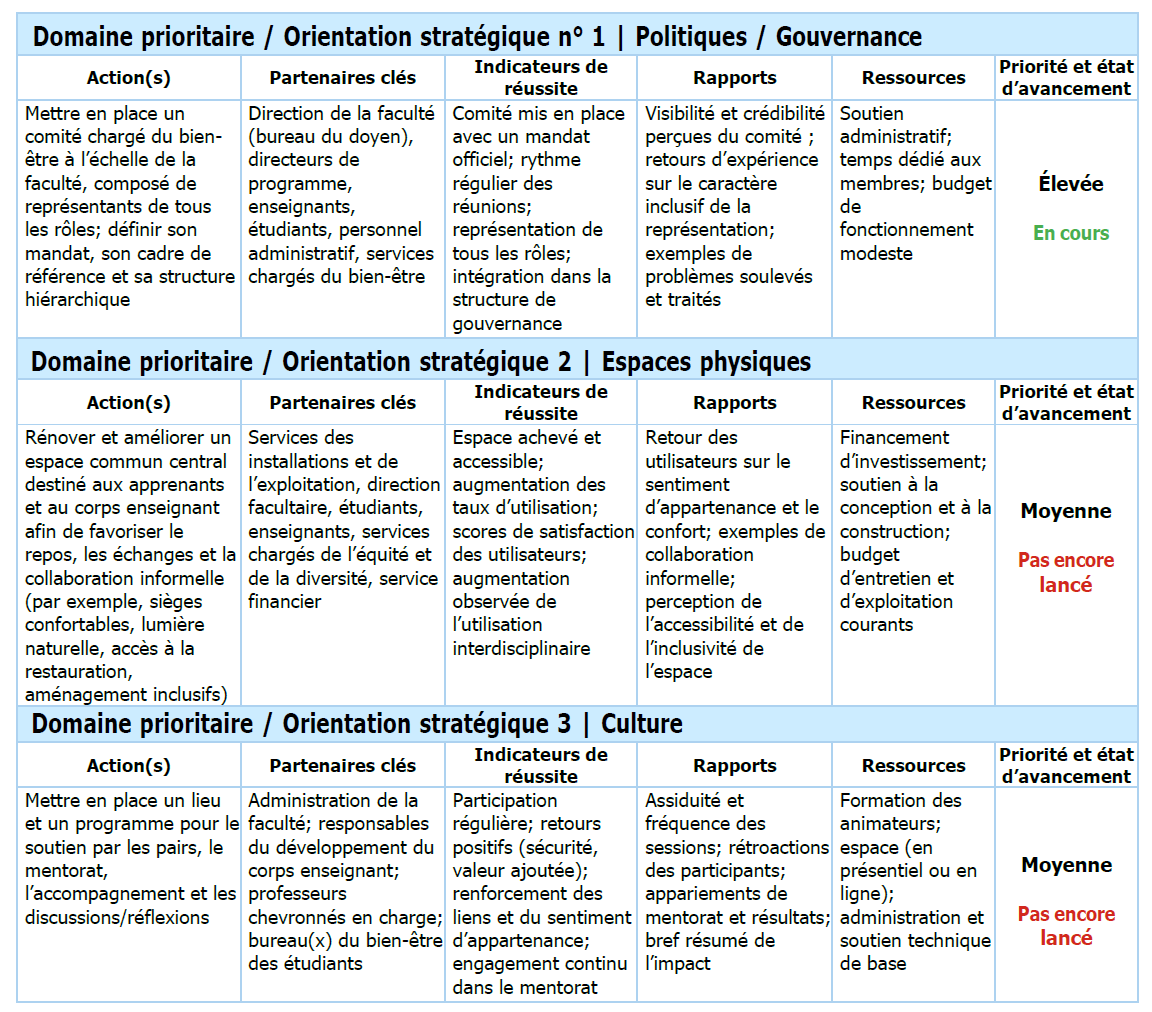
Exemple : Une évaluation des besoins menée au sein d’une faculté a mis en évidence une lacune en matière de gouvernance, notamment l’absence d’une structure formelle chargée de coordonner et de faire progresser les initiatives en faveur du bien-être. En réponse à cela, la création d’un comité du bien-être à l’échelle de la faculté a été identifiée comme une priorité. Le groupe a suivi le processus de planification et a soumis sa proposition au doyen afin d’obtenir son soutien.
Domaine prioritaire : Politiques / Gouvernance et leadership au service du bien-être
Actions : Mettre en place un comité de bien-être à l’échelle de la faculté, composé de représentants de tous les rôles; définir son mandat, son cadre de référence et sa structure hiérarchique
Partenaires clés : Direction de la faculté (bureau du doyen), directeurs de programme, enseignants, étudiants, personnel administratif, services chargés du bien-être
Indicateurs de réussite : Comité mis en place avec un mandat officiel; fréquence régulière des réunions (par exemple, trimestrielle); représentation de tous les rôles; intégration dans la structure de gouvernance.
Rapports : Perception de la visibilité et de la crédibilité du comité; retours d’expérience sur le caractère inclusif de la représentation; exemples de problèmes soulevés et traités.
Ressources nécessaires : Soutien administratif; temps dédié pour les membres; budget de fonctionnement modeste.
Niveau de priorité : Élevé
Statut : En cours
Une fois que vous avez identifié vos besoins et détaillé votre liste de priorités, envisagez de créer un document de planification pour évaluer et suivre les progrès de toutes vos initiatives et actions. Il pourrait ressembler à ceci :
Questions de réflexion pour orienter la planification des priorités vers l’action
- Quels sont les domaines d’impact les plus urgents pour votre faculté à l’heure actuelle ? (Reportez-vous aux six orientations stratégiques.)
- Quelles actions, si elles sont mises en oeuvre rapidement, pourraient créer une dynamique dans d’autres domaines ? (Par exemple, améliorer les espaces partagés pour favoriser la collaboration)
- Quelles structures de gouvernance, quels comités ou quelles initiatives existants peuvent être mis à profit ou renforcés ?
- Comment allez-vous soutenir la mise en oeuvre grâce à une collaboration et une communication claire entre les différents rôles ?
- Comment allez-vous vous assurer que les initiatives sont visibles, mesurables et harmonisées aux objectifs de votre faculté ?
- Quelles ressources spécifiques sont nécessaires, et comment seront-elles obtenues ?
À retenir :
- Veillez à ce que le processus soit inclusif et représentatif
- Faites preuve de transparence quant à l’objectif et à l’utilisation des résultats
- Partager les résultats avec la communauté pour bâtir la confiance et créer une dynamique
- Réexaminer et mettre à jour régulièrement le processus dans le cadre d’une démarche continue et itérative
Les environnements favorables à la santé se construisent grâce à un réseau de personnes et de groupes capables d’influencer les politiques, les pratiques et la culture par le biais d’efforts coordonnés et collaboratifs. Si chacun contribue au bien-être, chacun le fait à sa manière.
En vous appuyant sur les priorités que vous avez identifiées, l’étape suivante consiste à déterminer qui est le mieux placé pour faire avancer ce travail.
Votre réseau peut inclure des personnes qui :
- définissent l’orientation et les priorités;
- fournissent des services et du soutien;
- recueillent et interprètent des données;
- constatent directement les effets de ces efforts;
- influencent la culture par leurs interactions quotidiennes;
- conçoivent et mettent en oeuvre des programmes et des initiatives.
La promotion de la santé est un domaine complexe et à plusieurs niveaux; lorsque les relations sont intentionnelles et que les contributions sont visibles, les institutions peuvent passer d’efforts isolés à une action coordonnée.
Un environnement favorable à la santé intègre l’EDIA, le bien-être et la justice sociale non pas comme des efforts parallèles, mais comme des éléments délibérément intégrés à la manière dont les personnes vivent, apprennent et travaillent au sein de cet environnement. Pour y parvenir, il faut disposer des leviers adéquats pour faire avancer les choses.
Un réseau solide permet de :
- tirer parti de la diversité des expertises et des points de vue à travers les différents rôles et disciplines;
- renforcer la collaboration et la communication, en réduisant les doublons et les lacunes;
- faire progresser l’équité et l’inclusion en tenant compte des expériences vécues dans la prise de décision;
- favoriser l’engagement et l’appropriation collective des initiatives en matière de bien-être;
- soutenir l’évaluation et l’amélioration continue grâce à de multiples sources de données;
- permettre une utilisation plus stratégique des ressources et renforcer les capacités;
- favoriser un changement de culture à tous les niveaux, de la direction aux apprenants
Ne vous limitez pas à votre établissement ! Élargir votre réseau à l’échelle régionale et nationale peut renforcer l’impact, favoriser l’apprentissage partagé et amplifier le changement !
Aspects clés de la cartographie de votre réseau
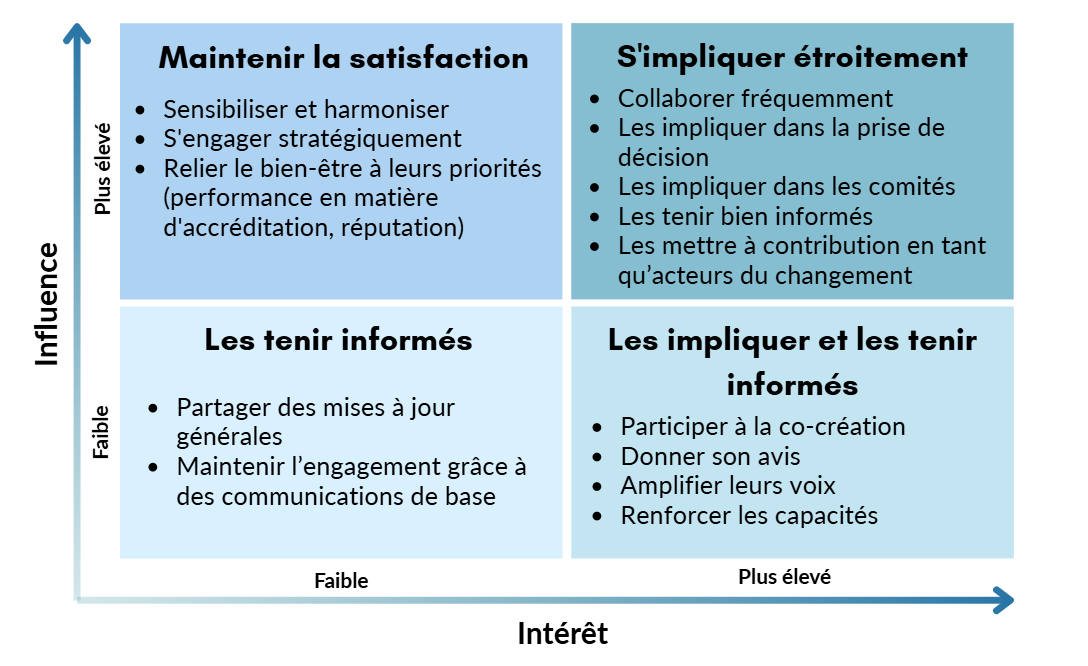
1. Identifiez vos leviers de changement : Toutes les personnes, tous les groupes ou toutes les entités concernées par ce travail ou susceptibles de l'influencer.
2. Déterminez leur niveau :
-
- d’influence : dans quelle mesure leurs actions peuvent-elles influencer le résultat ?
- d’intérêt dans quelle mesure le résultat affecte-t-il leurs besoins ?
3. Évaluez leur capacité à participer et trouvez des moyens de les impliquer Envisagez d’utiliser une grille d’analyse :
Questions de réflexion pour vous aider à cartographier votre réseau
- Qui sont les personnes ou les groupes clés qui contribuent actuellement au bien-être et à la promotion de la santé ?
- Qui manque à l’appel ou est sous-représenté, en particulier parmi les groupes méritant une attention particulière en matière d’équité ou occupant des rôles moins visibles ?
- Où existe-t-il déjà des liens et des collaborations solides ?
- Où les liens sont-ils faibles, cloisonnés ou inexistants ?
- Qui influence les politiques, les ressources et la prise de décision ?
- Qui façonne la culture et les expériences au quotidien au sein de votre faculté ?
- Comment les apprenants, le personnel, les enseignants et les patients/communautés s’impliquent-ils dans votre réseau ?
- Quels mécanismes existent (ou sont nécessaires) pour favoriser la communication, la cohérence et la responsabilité partagée ?
À retenir :
- La « fatigue de la représentation » : on demande souvent aux mêmes personnes d’apporter leur contribution à plusieurs reprises
- Envisager des possibilités d'accompagnement et de renforcement des compétences auprès des nouveaux contributeurs
- Veillez à ce que la participation soit mutuellement bénéfique et apporte une valeur ajoutée évidente à toutes les personnes concernées
- Dans la mesure du possible, offrez une reconnaissance, une rémunération ou du temps réservé pour favoriser l'engagement
Construire un réseau de membres du corps professoral promoteurs de la santé
Les facultés qui font la promotion de la santé s’articulent autour d’un réseau de rôles interconnectés. Si le leadership contribue à définir l’orientation, les changements significatifs sont portés par une action coordonnée et des expériences vécues à tous les niveaux. Des catalyseurs tels que l’EDIA et l’amélioration fondée sur les données favorisent l’harmonisation et l’impact à l’échelle du système.
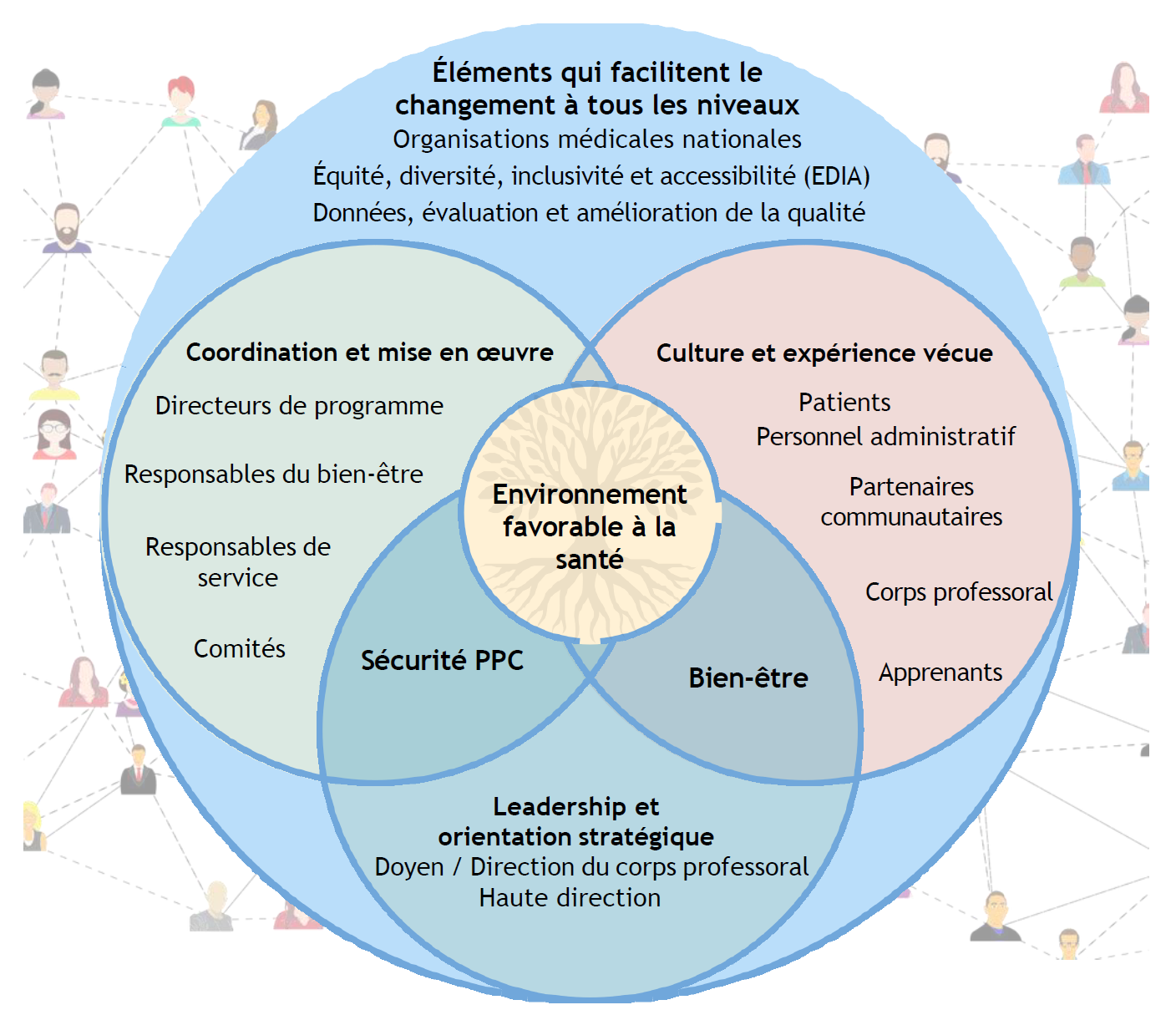
Le changement dans des environnements complexes prend du temps, mais les progrès sont portés par des actions claires, une responsabilité partagée et une dynamique soutenue. Plutôt que d’attendre des conditions idéales, concentrez-vous sur la mise en œuvre de mesures délibérées et réalisables qui contribuent à la réalisation d’objectifs à long terme.
Une fois les priorités identifiées et votre réseau en place, l’étape suivante consiste à traduire les plans en actions concrètes. Cela implique de passer des idées à une mise en œuvre coordonnée au sein de votre faculté.
Passer de la planification à l’action
Commencez par des actions rapides : Identifiez un petit nombre d’initiatives réalisables et à fort impact pour créer une dynamique.
Clarifiez les rôles et les responsabilités : Assurez-vous que les membres de votre réseau comprennent bien leurs contributions et leurs responsabilités.
Intégrez les actions dans les structures existantes : Alignez-vous, dans la mesure du possible, sur les comités, les processus de gouvernance et les initiatives en cours.
Communiquez de manière claire et cohérente : Partagez les priorités, les progrès et les possibilités d’engagement au sein de la faculté.
Allouez les ressources nécessaires : Veillez à ce que le temps, le financement et le soutien nécessaires soient en place pour pérenniser les efforts.
Suivez les progrès et adaptez-vous : Utilisez les données et les retours d’expérience pour affiner et améliorer vos actions au fil du temps.
La mobilisation n’est pas un effort ponctuel : elle nécessite une attention continue et des ajustements permanents.
Maintenir la dynamique
- Mettez en place des suivi réguliers et des mécanismes de reddition de comptes afin d’assuer la visibilité et la responsabilité
- Célébrez les premiers succès et les progrès réalisés pour renforcer l'engagement
- Soyez prêts à vous adapter à mesure que les besoins, les contextes et les priorités évoluent
- Renforcez l’idée que la responsabilité du bien-être est partagée dans l’ensemble du système et qu’elle n’incombe pas à une seule personne ou à un seul groupe.
Des actions précoces et visibles contribuent à démontrer les progrès accomplis, à instaurer la confiance et à susciter l’élan nécessaire à un changement plus large. Concentrez-vous sur ce qui est réalisable dès maintenant tout en œuvrant à une transformation à plus long terme.
Les progrès peuvent être progressifs, mais grâce à une action coordonnée et délibérée, les institutions peuvent évoluer, créant ainsi des environnements où le bien-être n’est pas une simple aspiration, mais fait partie intégrante de la manière dont la médecine universitaire est conçue et vécue.
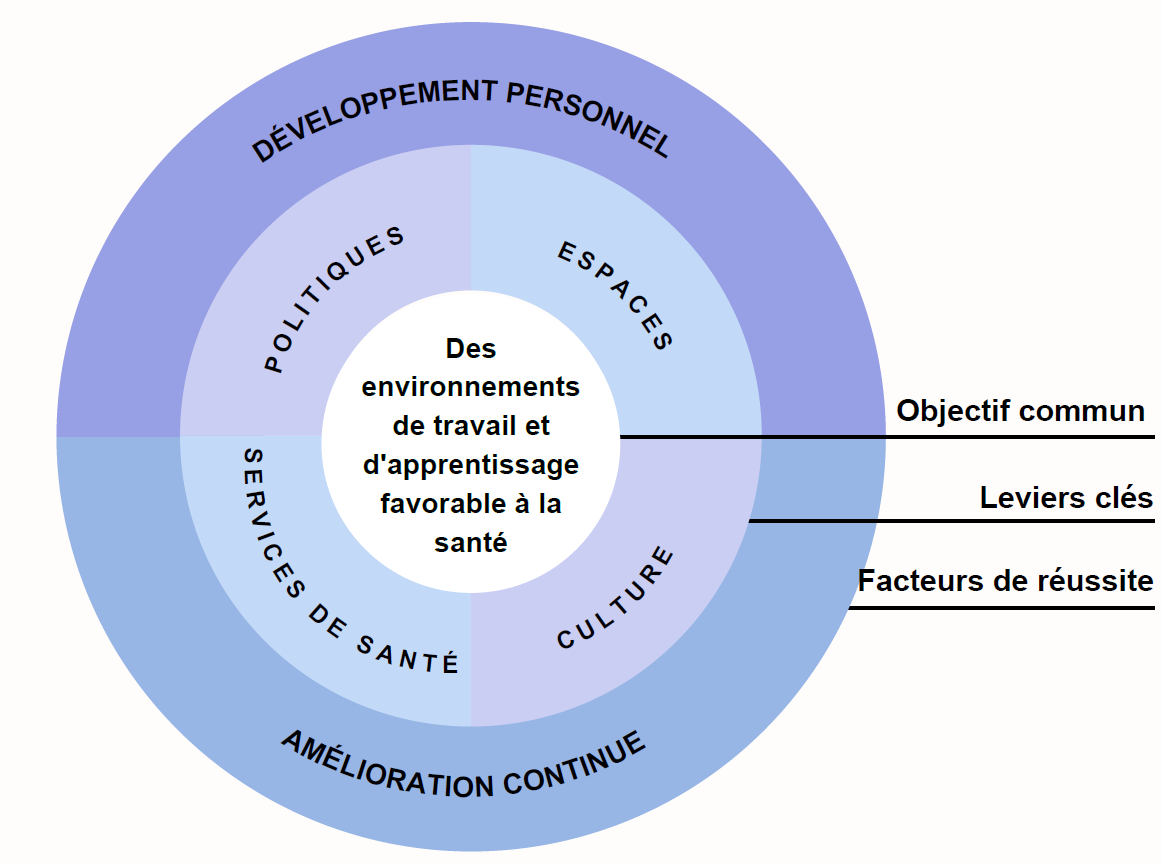
Les six orientations stratégiques ont été adaptées de la Charte de l’Okanagan pour s’inscrire dans le contexte de l’enseignement médical. Cette trousse d’outils propose des conseils et des mesures concrètes pour vous aider à mettre en oeuvre chacune de ces six orientations au sein de votre environnement, quel que soit votre rôle.
Une fois vos priorités définies, votre réseau établi et vos actions engagées, ces axes contribuent à garantir que vos efforts soient globaux, coordonnés et harmonisés à l’échelle du système.
Plutôt que d’aborder les initiatives de manière isolée, utilisez les orientations stratégiques pour organiser, renforcer et développer votre travail, en veillant à ce que les différents acteurs de la faculté collaborent pour favoriser le bien-être.
Les six orientations stratégiques de la Charte de l’Okanagan
1. Élaborer et mettre en oeuvre des politiques favorables à la santé
Examiner, élaborer et coordonner les politiques et les pratiques qui intègrent la santé, le bien-être, l’équité et la durabilité aux processus de planification, de prise de décisions, et de reddition de compte de l’établissement.
2. Créer des espaces durables, favorables et inclusifs
Créer et maintenir des environnements favorables, inclusifs et propices à la santé en aménageant de façon réfléchie les espaces physiques, naturels, sociaux, culturels, universitaires, organisationnels et virtuels qui influent sur les façons dont les personnes apprennent, travaillent, enseignent, mènent des recherches, tissent des liens et prodiguent des soins.
3. Favoriser l’épanouissement des communautés et de la culture médicales
Favoriser des environnements inclusifs, respectueux et psychologiquement sécuritaires.
4. Encourager, appuyer et entretenir le développement personnel
Offrir aux apprenants, aux membres du personnel et du corps professoral des possibilités de renforcer leurs compétences, leurs capacités personnelles, leur pratique réflexive et leurs aptitudes favorables à l’épanouissement, et ainsi contribuer au bien-être, au développement professionnel, à une participation significative au sein des collectivités locales et mondiales et à la création de milieux de soins de santé durables.
5. Évaluer, développer et renforcer les services de santé destinés au corps professoral
Coordonner et concevoir des services sur les campus afin de favoriser un accès équitable, de promouvoir la santé et le bien-être, de valoriser le potentiel humain et celui des écosystèmes, et de favoriser une culture organisationnelle axée sur le soutien.
6. Investir dans l’amélioration continue et l’évaluation
Utiliser les données, les évaluations et la rétroaction pour orienter l’amélioration continue.
Comment utiliser les orientations stratégiques
- Cartographiez vos initiatives actuelles selon les six orientations
- Identifiez les lacunes ou les déséquilibres
- Assurez-vous que les actions se renforcent mutuellement d’un domaine à l’autre
- Utilisez ce cadre pour faciliter la planification, la communication et l’évaluation
L’impact est maximal lorsque plusieurs orientations stratégiques sont mises en oeuvre conjointement. Par exemple, les changements apportés aux politiques, aux espaces et à la culture peuvent se renforcer mutuellement pour générer des améliorations plus significatives et durables.
Le travail de promotion de la santé se poursuit. À mesure que votre faculté progresse, il est important de faire régulièrement le point, de réfléchir et d’ajuster votre approche.
Revenez sur les étapes précédentes pour évaluer ce qui a changé :
- Vos priorités sont-elles toujours les plus pertinentes ?
- Votre réseau a-t-il évolué, et les bonnes personnes sont-elles impliquées ?
- Vos actions ont-elles l'impact escompté ?
Pérenniser les progrès
- Réévaluez régulièrement la situation à l’aide des données, des retours d’expérience et des témoignages concrets
- Adaptez vos priorités et vos actions à mesure que les besoins évoluent
- Renforcez ou élargissez votre réseau à mesure que de nouvelles occasions se présentent
- Continuez à ancrer le bien-être dans les structures, les processus et la culture
C’est un travail continu !
Les environnements favorables à la santé ne se construisent pas en une seule fois. Une réflexion, une adaptation et un apprentissage permanents sont essentiels pour garantir un changement significatif et durable.