


CAMi encourages Canadian academic medicine institutions to adopt and implement best practices and initiatives that foster respectful, inclusive, and health-promoting environments for the wellbeing of all.
It is estimated that approximately half of Canadian physicians and medical trainees are experiencing burnout, with some studies reporting rates as high as 75%.
The Situation
An environmental scan conducted within the academic medicine community reveals that the culture is widely perceived as toxic, with additional concerns about racism and the absence of psychologically safe environments. CAMi was established to respond to the urgent and ongoing health and wellbeing needs of physicians, researchers, administrators, and learners.
Our Response
In CAMi’s project, Towards Improved Provider Safety, the initiative aims to advance efforts on Physical, Psychological, and Cultural (PPC) Safety within the faculties of medicine in Canada by leveraging the strategic pillars of the Okanagan Charter and adapting ongoing implementation efforts to reflect safe, inclusive, and health-promoting principles.
What is a health promoting environment?
Environments that deliberately support the skills, aspirations, and challenges of learners, faculty and staff enabled by wellbeing-centered policy, communities of connection, resources that support patient care and personal growth, nested within inclusive spaces.
We focus on Canadian academic medicine which includes all environments where learners, faculty, researchers, educators, clinicians, and administrative staff learn, train, and work.
CAMI-TIPS Governance Model
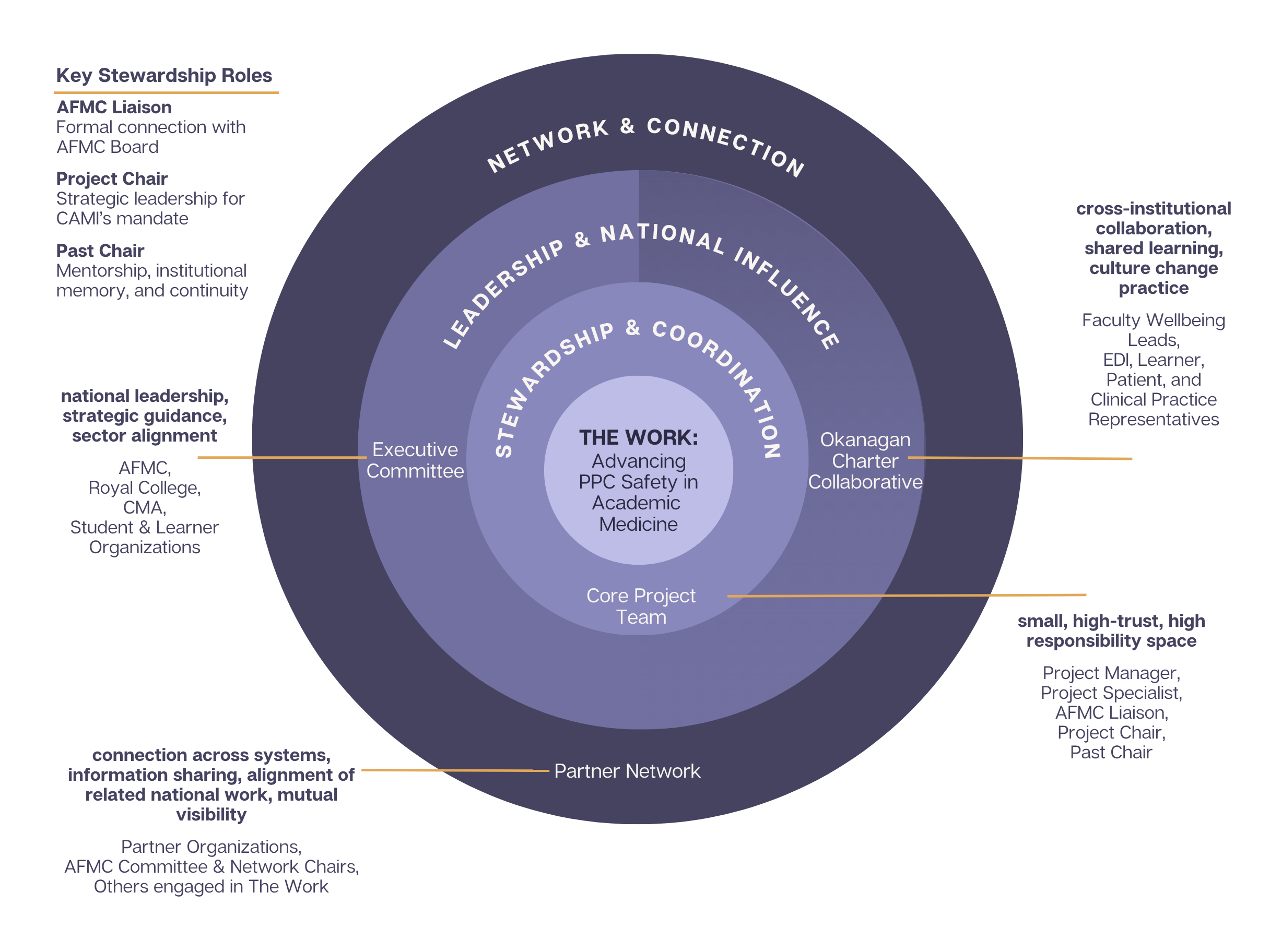
Meet the people who are advancing the Culture of Academic Medicine
The CAMi co-chairs provide dedicated leadership in the realm of wellbeing in medical education and oversee the implementation of the initiative’s strategic direction.

Constance LeBlanc
Dr. Constance LeBlanc is President and CEO of the Association of Faculties of Medicine of Canada (AFMC) and is instrumental in shaping and delivering on AFMC’s key priorities.
Originally from New Brunswick, Connie completed undergraduate studies at the Université de Moncton and medical education at Université Laval in Québec City. She has practiced tertiary care Emergency Medicine in Nova Scotia for over three decades. A lifelong learner, Connie holds a Master of Arts in Medical Education, an Executive Master’s in Business Administration and Technology, and most recently became a Canadian Certified Inclusion Professional. Dr. LeBlanc served in a decanal role for two terms as Associate Dean for Continuing Professional Development at Dalhousie University in Halifax, Nova Scotia. Her scholarship focuses on Equity, Diversity, Inclusivity & Accessibility (EDIA) and medical education with a strong academic track record in these areas. Connie is excited to collaborate with the committee of Deans and tackle important issues for academic medicine in Canada.

Victor Do
Victor is a co-chair of the Culture of Academic Medicine Initiative.
He is a hospital-based pediatrician in Edmonton at the Stollery Children’s Hospital and University of Alberta Department of Pediatrics.
Victor has been involved in advancing the Okanagan Charter in Canada for the last 10 years and his scholarly work has advanced physician and learner wellbeing with publications in journals including Academic Medicine and international presentations including a keynote address at the 2024 International Congress on Academic Medicine
Victor’s past leadership roles include CFMS President (2019-2020), CMA board member (2020-2021) and Royal College council member (2023-25).
The CAMi Executive Committee is composed of subject matter experts who provide direction on the initiative’s strategic goals, guide evaluation efforts, and ensure alignment with the broader goals and initiatives of the medical community. Their work helps to avoid duplication of efforts and fosters collaboration across the continuum of care.

Caroline Gerin-Lajoie
Dr. Gérin-Lajoie leads a team who strives to improve physician and learner wellness and drive positive change in the culture of medicine. In support of the CMA’s health workforce strategic pillar, advocacy, measurement, collaboration and innovation are applied to support a culture in practice and learning environments that is safe, inclusive and health-promoting.
Physicians’ physical, psychological and cultural safety | CMA

Melanie Lewis
Dr. Melanie Lewis serves as the Chief Wellness Officer for the Faculty of Medicine and Dentistry at the University of Alberta since 2021. In 2024, she was appointed the Steering Committee Chair for the Royal College of Physicians and Surgeons Wellbeing Taskforce, which has nation-wide recognition and impact. In addition to these roles, she also serves the AFMC as co-chair of the Wellbeing Committee and as an executive member of the AFMC Culture of Academic Medicine Initiative (CAMI) including the implementation of the Okanagan Charter.

Melanie Jaeger
Melanie Jaeger is an Associate Professor and Anesthesiologist at Queen’s University. Her involvement in postgraduate medical education evolved into physician wellbeing and she is now the Physician Wellness Lead at Queen’s University and the Southeastern Ontario Academic Medical Organization, as well as the co-chair of the Wellbeing Committee for the AFMC. Her focus is on system-level change needed to support wellbeing.
CAMi’s Project Team facilitates the day-to-day operations and implements the strategic directions of the initiative.
CAMi’s working groups include the following:
CAMI Partner Network
The CAMI Partner Network provides insight into their current environment, offers advice on CAMi’s objectives, and identifies obstacles and/or opportunities to implementation of the Okanagan Charter within the faculties of medicine in Canada.
Who’s involved?
- AFMC Committees and Networks co-chairs
- Medical Education Organization leadership
- Other Medical Organizations participants
- Academic Medicine Learner Organization leaders
Okanagan Charter Collaborative
In 2022 the AFMC established the Okanagan Charter Collaborative (OCC) to advance CAMI’s institutional strategy. The OCC develops resources and shares best practices to enable the implementation of the Okanagan Charter: An International Charter for Health Promoting Universities and Colleges within Canadian Faculties of Medicine.
Who’s involved?
- Wellbeing leadership from each Faculty of Medicine
- National EDIB Organizations
- Learner representation
- Patient representation
How can you get involved?
AFMC has endorsed the Okanagan Charter: An international Charter for Health Promoting Universities and Colleges, and through CAMi works with the 18 faculties towards implementation and action.
Attend the CAMI Wellbeing Matters Webinar Series!
We engage with experts in the academic medicine community, promoting partnership and collaboration on our common goals to improve physician and learner wellbeing.
An initiative of AFMC

The Association of Faculties of Medicine of Canada (AFMC) recognizes that promoting health and wellbeing is essential to achieving the full potential of all those engaged in academic medicine.
The Canadian Medical Association,
MD Financial Management Inc. and Scotiabank proudly support CAMI-TIPS, one of several initiatives that comprise their $115 million commitment to supporting the medical profession and advancing health in Canada.