Wellbeing Matters

An Okanagan Charter Implementation Toolkit

Wellbeing Matters

An Okanagan Charter Implementation Toolkit

Toolkit Navigation

Collaborate & Invest in Continuous Quality Improvement and Evaluation

Foster a culture of ongoing learning, adaptation, and improvement by using evidence, feedback, and evaluation to guide decision-making, strengthen accountability, and sustain health-promoting environments.

CQI & Evaluation: At-a-Glance

What is this strategic direction about?
Using evidence, feedback, evaluation, and quality improvement to strengthen decision-making, organizational learning, and sustained action.

Why does it matter?
Learning from experience helps institutions understand what is working, identify opportunities for improvement, and adapt their approaches over time.

What will I do here?
Explore practical approaches to evaluation, quality improvement, organizational learning, accountability, and continuous improvement.

What you’ll find in this section

  • Overview: Why CQI Matters
  • Key Components of CQI & Evaluation
  • Putting CQI & Evaluation into Practice
  • Case Studies
  • Explore Your Role in CQI & Evaluation
  • Tools and Resources

Overview

Why CQI & Evaluation Matters

Creating health-promoting learning and work environments requires more than good intentions. To understand whether efforts are making a meaningful difference, institutions must be able to learn from experience, assess progress, and adapt over time.

Continuous improvement and evaluation provide the mechanisms for doing so. Together, they help institutions understand what is working, identify opportunities for improvement, and make informed decisions about where to focus resources and effort. They also help demonstrate accountability to learners, faculty, staff, leadership, accreditation bodies, and health system partners.

Importantly, evaluation is not simply about collecting more data. Many Faculties of Medicine already have access to surveys, utilization data, accreditation findings, human resources metrics, and feedback from learners, faculty, and staff. The challenge is often not a lack of information, but rather how that information is interpreted, shared, and translated into meaningful action.

Continuous improvement is most effective when evaluation, quality improvement, and governance work together. Measurement helps institutions understand their current state, quality improvement helps test and refine changes, and governance ensures that findings inform decisions and accountability.

Measurement without action is reporting. Continuous improvement requires governance, interpretation, and visible action.

How CQI & Evaluation Connects to Other Strategic Directions in the Okanagan Charter

Continuous improvement and evaluation help institutions understand what is working, identify opportunities for growth, and strengthen health-promoting environments over time. This work supports learning and accountability across all Strategic Directions.

Evaluation can inform policy development, implementation, review, and accountability.

Assessment and feedback help identify opportunities to improve the accessibility, safety, inclusiveness, and effectiveness of environments.

Measurement and dialogue can help institutions understand cultural strengths, monitor progress, and address barriers to wellbeing and inclusion.

Evaluation can guide the design and improvement of learning, mentorship, coaching, and development initiatives.

Data, feedback, and quality improvement approaches help strengthen access, coordination, responsiveness, and effectiveness of health services.

Key Components of Effective CQI & Evaluation

Continuous improvement is most effective when it is embedded within organizational structures, decision-making processes, and everyday practice. While approaches will vary across institutions, several key components consistently contribute to meaningful and sustainable improvement.

Continuous improvement requires clear leadership, defined responsibilities, and structures that ensure findings inform decision-making.

Governance ensures that evaluation findings do not remain reports on a shelf. Effective governance structures create accountability for reviewing evidence, setting priorities, allocating resources, and acting on what is learned.


Examples may include:

  • Clearly defined leadership and accountability structures.
  • Integration of wellbeing priorities into strategic planning.
  • Regular review and oversight of evaluation findings.
 

Effective evaluation begins with clarity about what is being measured and why. Data collection should be guided by improvement goals rather than the availability of measurement tools.

Evaluation should consider both indicators of challenge (e.g., burnout, distress, barriers) and indicators of strength (e.g., belonging, professional fulfillment, psychological safety, engagement, and meaningful participation).


Examples may include:

  • Clearly defined evaluation questions.
  • Meaningful indicators linked to institutional priorities.
  • Use of validated and evidence-informed measures where appropriate.
 

*Evaluation and data collection activities should comply with applicable privacy legislation, ethical requirements, and institutional policies.

No single measure can fully capture the complexity of health-promoting learning and work environments. Effective evaluation combines multiple forms of evidence to create a more complete understanding of experiences, outcomes, and opportunities for improvement.


Examples may include:

  • Quantitative data
  • Qualitative insight and lived experience
  • Operational, workforce, and organizational indicators
 

Evaluation, Quality Improvement, and Research: What’s the Difference?


Evaluation:
Are we achieving what we intended to achieve?

Quality Improvement:
How can we improve processes and outcomes in real time?

Research:
What new knowledge can we generate that may be applicable beyond our institution?


While these approaches often overlap, this strategic direction focuses primarily on evaluation and quality improvement as tools for organizational learning and improvement.

Evaluation should consider how experiences and outcomes may differ across groups and ensure that improvement efforts do not unintentionally reinforce inequities.


Examples may include:

  • Inclusive and culturally responsive evaluation practices.
  • Consideration of diverse perspectives and experiences.
  • Attention to barriers, participation, and outcomes across groups.
 

Continuous improvement depends on an institution’s ability to learn, adapt, and respond to emerging information. Evaluation helps identify opportunities for improvement, while quality improvement supports the testing and refinement of changes over time.


Examples may include:

  • Iterative learning and adaptation.
  • Continuous monitoring and reflection.
  • Use of improvement methodologies to guide change.
 

Continuous improvement focuses on patterns and progress over time rather than isolated results. Baseline assessments, repeat measurements, and ongoing review cycles help institutions understand whether changes are leading to meaningful improvement.

Improvement efforts are strengthened when institutions learn from one another, share resources, and collaborate around common challenges.


Examples may include:

  • Participation in collaborative networks.
  • Sharing resources and promising practices.
  • Benchmarking and cross-institutional learning.
 

While local context matters, greater alignment in approaches to measurement and evaluation can support benchmarking, reduce duplication, strengthen shared learning, and help build a more comprehensive understanding of wellbeing across Canadian medical education.

Evaluation builds trust when people can see how their input informs action. Closing the loop ensures that findings are communicated transparently and connected to visible improvements.


Examples may include:

  • Sharing findings with the community.
  • Communicating actions taken in response to feedback.
  • Providing updates on progress and outcomes.
 

Closing the Loop in Practice

  • Collect information
  • Interpret findings
  • Take action
  • Communicate what changed
  • Repeat
 

Trust is strengthened when individuals can see how their feedback contributes to decisions, priorities, and tangible improvements. Low response rates are often not a lack of interest in wellbeing; they are a lack of confidence that feedback will lead to change.

Putting CQI & Evaluation Into Practice

Continuous improvement is not a single project, annual survey, or accreditation exercise. It is an ongoing cycle of learning, action, reflection, and adaptation. Effective Faculties of Medicine create systems that support continuous learning by gathering information, making sense of it, acting on what is learned, and revisiting progress over time.

A Continuous Improvement Cycle

Effective improvement efforts begin with clear leadership, responsibility, and oversight.


Potential actions may include:

  • Establish a Health-Promoting Learning Environment (HPLE) or wellbeing working group.
  • Define leadership roles and accountability structures.
  • Integrate wellbeing priorities into strategic planning processes.
  • Identify resources to support evaluation and improvement activities.
  • Establish reporting and decision-making processes.
 

Questions to consider:

  • Who is responsible for overseeing this work?
  • How will findings inform decisions?
  • How will accountability be maintained over time?
 

Improvement efforts are more likely to succeed when responsibility for evaluation, decision-making, and action is clearly defined.


The Institute for Healthcare Improvement offers practical guidance on Forming the Team.

Before collecting data, define the outcomes and experiences you hope to influence.


Potential actions may include:

  • Identify strategic priorities and areas of concern.
  • Define intended outcomes and indicators of success.
  • Determine who is expected to benefit.
  • Establish realistic expectations for improvement.
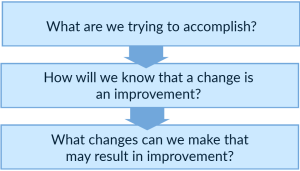


The Institute for Healthcare Improvement – Model for Improvement can be a helpful starting point.

Many institutions already possess valuable information that can inform improvement efforts.


Potential actions may include:

  • Review previous survey findings and reports.
  • Examine human resources and workforce data.
  • Consider accreditation findings and recommendations.
  • Analyze service utilization and operational data.
  • Review feedback gathered through committees, consultations, and focus groups.
  • Explore external benchmark and comparison data.


Before Collecting New Data

Consider whether relevant information already exists through:

  • Institutional surveys
  • Accreditation reviews
  • Human resources and workforce data
  • Health service utilization data
  • Workforce indicators
  • Previous consultations and focus groups
 

Reviewing existing evidence can help identify priorities, reduce duplication, and prevent unnecessary data collection.


Canadian Medical Association National Physician Health Survey Reports Provides national physician wellbeing data that can serve as a comparison point or contextual benchmark.

When additional information is needed, collect data purposefully and proportionately.


Potential actions may include:

  • Use validated instruments where appropriate.
  • Conduct interviews, focus groups, or listening sessions.
  • Implement pulse surveys or targeted assessments.
  • Gather both qualitative and quantitative information.
  • Minimize duplication and participant burden.
 

Only collect information that will help inform decisions, improvement efforts, or future action.


Important Consideration

More data is not always better data. Excessive surveying without visible action can contribute to survey fatigue and reduce trust in evaluation processes.


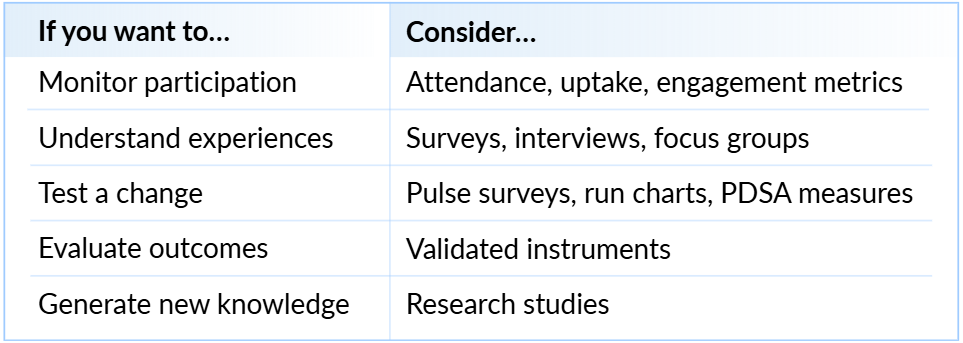
Match the Measurement to the Question
 

Helpful Resources

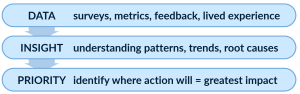
Data becomes meaningful when reviewed, discussed, and understood within context.


Potential actions may include:

  • Review findings with key partners and interest holders.
  • Explore trends, patterns, and contributing factors.
  • Consider equity implications and unintended consequences.
  • Combine quantitative findings with qualitative insight.
  • Identify priority areas for action.
 

Focus on understanding what the information means, not simply what it says.


Canadian Evaluation Society Competencies for Canadian Evaluation Practice could be a helpful resource for understanding principles of interpretation, partner engagement, and use-focused evaluation.

Use findings to guide improvement efforts and inform action.


Potential actions may include:

  • Apply quality improvement methodologies such as PDSA cycles.
  • Pilot new approaches on a small scale.
  • Monitor implementation progress.
  • Refine initiatives based on feedback and results.
  • Scale successful approaches where appropriate.
 

Small, iterative improvements are often more sustainable than large-scale change efforts.
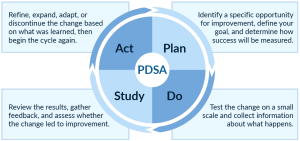


Helpful Resources:


Once a change has shown promising results, this assessment can help determine whether it is ready to be expanded across departments, programs, sites, or institutions.

Visible action strengthens trust and supports ongoing engagement.


Potential actions may include:

  • Share findings with learners, faculty, staff, and partners.
  • Communicate actions taken in response to feedback.
  • Provide updates on progress and outcomes.
  • Recognize contributions from participants and partners.
  • Create opportunities for continued dialogue.
 

Trust is built when people can see how their feedback informs decisions, priorities, and tangible improvements.
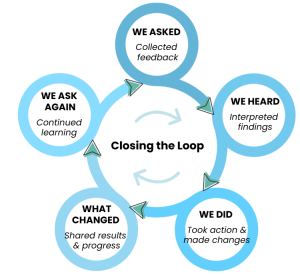
 

Continuous improvement is an ongoing process rather than a final destination.


Potential actions may include:

  • Revisit priorities regularly.
  • Monitor trends and outcomes over time.
  • Adapt strategies as needs evolve.
  • Embed evaluation into routine operations.
  • Share learning across programs, departments, and institutions.
 

Examples of indicators of success:

  • Increased engagement in evaluation activities.
  • Improved confidence in evaluation and feedback processes.
  • Evidence of action taken in response to feedback.
  • Stronger collaboration across units and institutions.
  • Improved alignment between priorities, initiatives, and outcomes.
  • Demonstrated progress toward health-promoting learning and work environments.
 

The goal of continuous improvement is not to produce more reports. It is to create learning systems that help Faculties of Medicine make better decisions, strengthen health-promoting environments, and sustain meaningful change over time.

Case Studies

Continuous improvement is most meaningful when applied to real situations. These case studies illustrate common challenges faced in Faculties of Medicine and demonstrate how evidence, reflection, collaboration, and action can be used to guide improvement. As you work through each case, consider how the lessons might apply within your own context.

Case Study #1: “We Keep Asking, But No One Is Answering”

Case Study #2:The Canary in the Coal Mine”

There is rarely a single cause, or a single solution. Many wellbeing challenges span multiple strategic directions and require coordinated, systems-level responses.

Case Study #1

We Keep Asking, But No One Is Answering”

A Faculty of Medicine launched an annual wellbeing survey for learners, faculty, staff, and researchers. Despite repeated reminders, response rates remain low, particularly among clinical faculty and residents.

Informal feedback suggests that many people feel “nothing ever changes” as a result of these surveys. Others express concerns about confidentiality, especially within smaller departments. Leaders are frustrated by the lack of data, while members of the faculty community are increasingly reluctant to participate. Trust in the evaluation process is beginning to erode.

The faculty is collecting wellbeing data, but participation continues to decline. Without sufficient engagement, it becomes difficult to understand community needs, evaluate progress, or identify priorities for improvement.

The challenge is not simply how to increase response rates, but how to rebuild trust and demonstrate that evaluation leads to meaningful action.

Low participation is often interpreted as survey fatigue or disengagement. However, it may also signal concerns about confidentiality, uncertainty about how information will be used, or a lack of confidence that feedback will result in change.

Effective evaluation depends on trust. When people do not see visible action resulting from their input, future participation and engagement often decline.

Governance and Accountability: Clear ownership and accountability are needed to ensure feedback is reviewed, prioritized, and acted upon.

Purposeful and Meaningful Measurement: Evaluation efforts should be designed to inform decisions and improvements, not simply collect data.

Quality Improvement and Adaptive Learning: Feedback should be used to test changes, learn from results, and refine future approaches.

Closing the Loop: Trust is strengthened when participants can see how their input informs actions and improvements.

For Leaders and Decision-Makers

  • What messages have we communicated about how wellbeing data is used?
  • How often do we share findings and actions with the community?
  • Are we collecting information that we are prepared to act upon?


For Faculty, Staff, Learners, and Researchers

  • What would make participation feel worthwhile?
  • What concerns exist around confidentiality or identification?
  • What would increase confidence that feedback leads to change?


For System-Level Reflection

  • Who is responsible for reviewing and acting on findings?
  • How are priorities for action determined?
  • How do we know whether evaluation processes are building or eroding trust?

Consider a recent survey, consultation, listening session, or feedback process within your institution:

  • What information was collected?
  • What actions followed?
  • Were results shared with the community?
  • Did participants see evidence that their input influenced decisions?
  • What might improve participation and trust in future evaluation efforts?

Applying a Continuous Improvement Lens:


1. What Evidence Already Exists?

Before launching another survey, review existing sources of information.

Examples may include:

  • Previous wellbeing surveys
  • Accreditation findings
  • Focus groups and listening sessions
  • Human resources data
  • Health service utilization data
  • Committee reports and recommendations


2. What Is the Real Problem?

Explore why participation may be declining.

Possible contributing factors include:

  • Survey fatigue
  • Concerns about confidentiality
  • Lack of visible follow-through
  • Competing demands and workload pressures
  • Unclear purpose or value of participation


3. Which Strategic Directions May Be Contributing?

This challenge may involve multiple areas of the toolkit:

Policy: Are there clear expectations for reporting back on evaluation findings?

Culture: Do individuals trust that feedback will be used constructively?

Personal Development: Are leaders equipped to discuss findings and facilitate local improvements?

Health Services: Have previous evaluation findings informed visible improvements to supports and services?

Continuous Improvement and Evaluation: Are governance structures in place to review findings, prioritize actions, and close the loop?


4. What Improvement Actions Could Be Tested?

  • Coordinating evaluation activities across units to reduce duplication.
  • Simplifying surveys and focusing on high-priority questions.
  • Introducing alternative feedback mechanisms such as listening sessions or focus groups.
  • Developing a formal “We Asked, We Heard, We Did” communication process.
  • Establishing a wellbeing working group responsible for reviewing findings and monitoring follow-up actions.


5. How Would You Know If Improvement Is Occurring?

  • Increased participation rates.
  • Improved trust in evaluation processes.
  • Greater awareness of actions taken in response to feedback.
  • Increased engagement in consultations and improvement initiatives.
  • Evidence of changes implemented as a result of community input.

Low survey participation is often a symptom rather than the problem itself. Continuous improvement requires more than collecting information—it requires governance, trust, visible action, and ongoing communication. When people can see how their feedback informs decisions and improvements, engagement becomes more meaningful and sustainable.

Case Study #2

The Canary in the Coal Mine”

A Faculty of Medicine reviews its annual wellbeing survey results. Rates of burnout, moral distress, and emotional exhaustion are elevated across multiple groups, including learners, faculty, and staff.

Leadership acknowledges the findings, but discussion quickly shifts toward questions about the data. Are these results driven by workload, culture, system pressures, broader societal stressors, or something else entirely? Why do some units appear to be struggling more than others? Do the results reflect temporary challenges or deeper organizational issues?

Some leaders argue that the findings are too nonspecific to guide action. Others worry that acting without clear evidence of causation could lead to ineffective interventions. As discussions continue, no concrete changes are implemented, and similar patterns appear in subsequent surveys.

The faculty has identified a concerning signal, but uncertainty about its meaning has created paralysis. Leaders are reluctant to act without definitive explanations, while members of the faculty community become increasingly frustrated that concerns continue to be measured but not addressed.

The challenge is not whether distress exists, but how to respond when evidence points to a problem before the root causes are fully understood.

In mining, canaries were once used as an early warning system for toxic gases. The canary could not identify the source of the danger, but it signaled that something required attention.

Wellbeing data often function in a similar way. Elevated burnout, moral distress, or psychological strain may not explain precisely what is wrong, but they can indicate that further exploration and action are needed.

Continuous improvement depends on recognizing these signals, investigating them thoughtfully, and responding proportionately rather than waiting for perfect certainty.

Purposeful and Meaningful Measurement: Wellbeing measures can help identify areas of concern, even when the underlying causes are not yet fully understood.

Multiple Sources of Evidence: Survey findings are most useful when interpreted alongside qualitative feedback, operational data, and lived experience.

Quality Improvement and Adaptive Learning: Continuous improvement encourages organizations to test and refine responses rather than waiting for perfect certainty.

Interpretation and Sense-Making: Data become actionable when they are discussed, contextualized, and translated into priorities for improvement.

For Leaders and Decision-Makers

  • What assumptions do we make when we see elevated distress scores?
  • How much certainty do we believe is necessary before action should occur?
  • What risks arise when we wait for definitive explanations before responding?


For Evaluation and Improvement Teams

  • What additional information might help explain these findings?
  • Are there patterns across roles, departments, career stages, or locations?
  • What existing sources of evidence could help deepen understanding?


For Faculty, Staff, Learners, and Researchers

  • Do these findings resonate with lived experience?
  • What factors seem most connected to wellbeing challenges in your environment?
  • What actions would demonstrate that leadership is taking these findings seriously?

Consider a recent survey, report, or consultation that identified a concern within your institution:

  • How was the information interpreted?
  • What additional evidence was sought?
  • Were actions implemented while further learning continued?
  • Did uncertainty lead to exploration, or did it delay decision-making?
  • How might your institution respond differently in the future?

Applying a Continuous Improvement Lens


1. What Evidence Already Exists?

Before collecting additional information, review existing sources of evidence.

Examples may include:

  • Wellbeing surveys
  • Focus groups and listening sessions
  • Accreditation findings
  • Human resources and workforce data
  • Turnover, absenteeism, or leave data
  • Health service utilization data
  • Incident reports or professionalism concerns


2. What Is the Signal Telling Us?

The goal is not to identify a single cause immediately, but to understand what the data may be signaling.

Possible contributing factors include:

  • Workload and staffing pressures
  • Moral distress related to system constraints
  • Psychological safety concerns
  • Inequities across roles, departments, or learner groups
  • Barriers to support and recovery


3. Which Strategic Directions May Be Contributing?

This challenge may involve multiple areas of the toolkit:

Policy: Are workload, scheduling, accommodation, or leave policies contributing to strain?

Spaces: Do learning and work environments support restoration, connection, and wellbeing?

Culture: Are psychological safety, respect, and belonging being experienced consistently across the organization?

Personal Development: Do individuals have access to mentorship, coaching, reflection, and professional growth opportunities?

Health Services: Are supports accessible, trusted, and responsive to community needs?

Continuous Improvement and Evaluation: Are findings being interpreted, discussed, and acted upon in a structured way?


4. What Improvement Actions Could Be Tested?

  • Conducting focused consultations within areas experiencing elevated distress.
  • Reviewing workload, scheduling, or staffing patterns.
  • Implementing targeted pilot initiatives in high-concern units.
  • Increasing opportunities for dialogue and feedback.
  • Strengthening leadership visibility and communication around wellbeing priorities.
 

The goal is not to solve every issue immediately, but to begin learning through action.


5. How Would You Know If Improvement Is Occurring?

  • Improved wellbeing survey results over time.
  • Increased psychological safety and trust.
  • Reduced reports of distress or moral strain.
  • Greater engagement in improvement initiatives.
  • Positive feedback regarding organizational responsiveness.

Wellbeing data are often early warning signals rather than definitive explanations. Continuous improvement does not require perfect certainty before action can begin. By combining multiple sources of evidence, exploring patterns thoughtfully, and testing proportionate responses, Faculties of Medicine can learn from the signal rather than becoming stalled by the search for a single cause.

Exploring Your Role in CQI and Evaluation

Continuous improvement depends on collective learning. While evaluation specialists and institutional leaders often guide improvement efforts, meaningful change requires participation from everyone who experiences, delivers, or influences learning and work environments.

This section explores how different roles contribute to feedback, learning, decision-making, and ongoing improvement.

Reflect on Your Role

How do I contribute to learning, improvement, and accountability within my environment?


What information or experiences can I share to help identify opportunities for change?

How can I help ensure that feedback leads to meaningful action?

Moving from Data to Action

Continuous improvement is not the responsibility of a single committee or leader. Sustainable change occurs when individuals across the institution contribute to a culture of learning, reflection, and shared accountability.

Senior leaders create the conditions that allow continuous improvement to occur. By establishing priorities, allocating resources, and embedding accountability into governance structures, they help ensure evaluation findings lead to meaningful action.


How This Role Contributes to Supportive Health Services

  • Embed wellbeing and continuous improvement into strategic plans and governance structures.
  • Allocate financial, human, and analytical resources to support evaluation and improvement activities.
  • Establish clear accountability for reviewing findings and implementing change.
  • Support cross-functional collaboration across academic, clinical, research, and administrative environments.
  • Promote transparency by communicating progress, challenges, and lessons learned.
  • Align local efforts with accreditation requirements, institutional priorities, and broader initiatives.
 

Visible action builds credibility. People are more likely to engage in evaluation when they see leaders responding to what is learned.

Operational leaders and staff help translate strategy into practice. They coordinate evaluation activities, support implementation efforts, and help teams use information to drive practical improvements.


How This Role Contributes to Supportive Health Services

  • Coordinate local evaluation and quality improvement activities.
  • Reduce duplication and survey fatigue by aligning feedback processes.
  • Support teams in interpreting findings and identifying opportunities for improvement.
  • Facilitate implementation of local improvement initiatives.
  • Monitor progress and communicate outcomes.
  • Escalate barriers, resource needs, and emerging concerns to leadership.
 

Focus on making improvements visible. Small changes that are implemented and communicated often build more trust than large plans that remain unseen.

Faculty members contribute practical insight into how policies, systems, learning environments, and workflows affect wellbeing. Their experiences help ensure improvement efforts remain grounded in day-to-day realities.


How This Role Contributes to Supportive Health Services

  • Participate in evaluation, reflection, and improvement activities.
  • Share insights into barriers, challenges, and opportunities within learning and clinical environments.
  • Support a culture that values feedback and continuous learning.
  • Help identify emerging issues affecting learners, colleagues, and teams.
  • Participate in testing and refining changes within educational and clinical settings.
  • Promote approaches that support wellbeing alongside educational and patient care excellence.
 

Continuous improvement does not always require large-scale change. Identifying and addressing small, local barriers can have meaningful impact over time.

Learners and trainees bring valuable lived experience and often identify emerging issues before they become visible through formal reporting processes. Their perspectives help ensure improvement efforts reflect the realities of learning environments.


How This Role Contributes to Supportive Health Services

  • Share experiences through surveys, focus groups, consultations, and feedback processes.
  • Help identify emerging concerns and areas requiring attention.
  • Participate in co-design and improvement initiatives.
  • Contribute to interpreting findings from a learner perspective.
  • Advocate for transparency and accountability in evaluation processes.
  • Support respectful dialogue and constructive engagement.
 

Your perspective is a form of evidence. Lived experience provides important context that helps organizations understand what data alone cannot explain.

Researchers and scientists contribute methodological expertise, systems thinking, and a commitment to evidence-informed decision-making. They help strengthen evaluation practices and bring attention to the unique realities of research environments.


How This Role Contributes to Supportive Health Services

  • Bring expertise in measurement, evaluation, and data interpretation.
  • Apply systems thinking to understand complex organizational challenges.
  • Identify wellbeing issues and opportunities within research environments.
  • Support evidence-informed decision-making and improvement efforts.
  • Translate local findings into scholarship and shared learning.
  • Strengthen the evidence base for health-promoting learning and work environments.
 

Research and quality improvement serve different but complementary purposes. Researchers can help ensure improvement efforts are both practical and evidence-informed.

Moving Forward Together 

Continuous improvement is most effective when evaluation, quality improvement, and decision-making are connected. Whether gathering feedback, interpreting findings, testing changes, or communicating results, every role contributes to creating an institution that learns from experience and acts on what it learns.


How We Contribute Collectively

  • Gather and share meaningful information.
  • Listen to diverse perspectives and lived experiences.
  • Use evidence to guide decisions and improvement efforts.
  • Act on findings and communicate progress.
  • Learn from successes, challenges, and setbacks.
  • Support a culture of curiosity, reflection, and accountability.
 

Measurement informs improvement, but action creates it.

Tools and Resources

The tools and resources in this section are designed to support practical evaluation, quality improvement, and organizational learning. Whether you are planning an initiative, selecting measures, interpreting findings, or communicating results, these resources can help translate insight into action.

What you’ll find in this section 


Adapt and use what is most relevant to your context.

Continue exploring the toolkit:

PREVIOUS SECTION

Review, Develop, and Strengthen Faculty Health Services

NEXT SECTION

Explore our Tools and Resources

Developed by the Association of Faculties of Medicine of Canada’s Culture of Academic Medicine Initiative (CAMI) in collaboration with the Okanagan Charter Collaborative.

Suggested Citation

Do, V. Wellbeing Matters: An Okanagan Charter Implementation Toolkit. Association of Faculties of Medicine of Canada (AFMC), Culture of Academic Medicine Initiative – Towards Improved Provider Safety (CAMI-TIPS); 2026. Available from: [URL placeholder]

Help Improve the Toolkit 

We welcome your feedback to help improve future versions of the toolkit. Questions, suggestions, and corrections are always appreciated.

Developed by the Association of Faculties of Medicine of Canada’s Culture of Academic Medicine Initiative (CAMI) in collaboration with the Okanagan Charter Collaborative.

Suggested Citation

Do, V. Wellbeing Matters: An Okanagan Charter Implementation Toolkit. Association of Faculties of Medicine of Canada (AFMC), Culture of Academic Medicine Initiative – Towards Improved Provider Safety (CAMI-TIPS); 2026. Available from: [URL placeholder]

Help Improve the Toolkit 

We welcome your feedback to help improve future versions of the toolkit. Questions, suggestions, and corrections are always appreciated.

Wellbeing Matters: An Okanagan Charter Implementation Toolkit ⋅ Version 1.0 ⋅ September 2026